The Offshore Journalism Toolkit
With Mario Tedeschini Lalli, we wrote an application for funding to Google’s Digital News Initiative, based on Mario’s vision for an offshore journalism. I republish an adapted version here.
The Offshore Journalism Toolkit is a series of components comprising legal advice, software and how-tos for publishers who want to create an offshore publication vehicle. It enables media outlets to pursue their efforts to seek, publish and remember facts and opinions in challenging legal environments.
The power of open data
This essay was written for the Transparency Camp of Vilnius, Lithuania, where I was, together with Anne-Lise Bouyer, invited to give a lecture on “the power of open data”.
Open Data represent information collected by an administration and offered for free to anyone in a machine-readable format. The concept gained popularity in the late 2000’s and is now hailed as the best path towards a “more efficient and transparent government”1.
The new legitimacy of power
This is the first part of a series on the evolution of power dynamics in Europe. Events in the last 6 months have shown that the rationale for political power in Europe has changed, though very few observers have noticed. This essay shows how it has changed. The next ones will focus on the reasons and, finally, on the role of journalism in this new normality.
During the French Civil War of 1793, when troops of the republic fought troops of the monarchy, they went into battle for “the Law”1. They fought so that power would not be used arbitrarily, but would find its source in rational rules that ensured the welfare of all.
Informer avec des données structurées
Cet essai est la base de ma présentation à l’école d’été de l’INRIA qui se tient à Marseille du 18 au 22 septembre 2016.
Depuis la fin des années 2000, le terme de datajournalisme a émergé. Certains médias ont mis en place des équipes de datajournalisme. Des agences spécialisées se sont créées, comme celle que j’ai cofondé en 2011, Journalism++. De nombreuses écoles de journalisme offrent des cours de datajournalisme. Des conférences spécialisées ont lieu tous les ans. Si le concept a montré qu’il était plus qu’un buzzword ou qu’une mode, il reste mal défini. Certains y voient une “mythologie du chiffre”1. D’autres affirment que le datajournalisme consiste à “s’adresser à l’intelligence visuelle” de son audience2. Ces raccourcis passent à côté de l’essentiel. Faire du datajournalisme, c’est informer avec des données structurées. C’est l’utilisation de techniques statistiques, de visualisations et d’interactivité pour analyser et communiquer des données3.
Free your data' is over. Now, we need data to be free.
My keynote at the Nordics Datajournalism Conference in Helsinki: Why it’s important for datajournalists to be more careful with government data and should collect more data independently.
You probably know that Finland has one of the best population data in the world. Finland was part of Sweden in the 18th century, at the time when the Kingdom decided to start counting its subjects regularly. This was the first modern population census and gave birth to the first modern public statistics office, the Tabular Bureau.
When to engage with adversarial organizations
I was recently invited to the DiploHack, a hackathon on the topic of transparency for civic tech activists and diplomats of the European Union, hosted by the Council of the EU.
First, a few words about the Council. This institution is what people mean when they describe the EU as an opaque bureaucracy led by unelected officials detached from the people. On most European legislation (and all legislation before 2009), the Council has the last word. It brings together ministers from all 28 member states. In most member states, ministers are unelected and accountable only to their prime minister - they are professional politicians above all. The Council takes decisions behind close doors, so that no one knows how it finds compromises. Most of the time, the Council refuses to communicate documents under the European freedom of information legislation. To oversimplify, the Council is what’s wrong about the EU.
Why the European Union failed
The European Union, as a political project, has failed[1]. From a supranational project, it has become a secretariat for the member states. Before we can imagine new ways of preventing war in Europe - the EU’s main mission - we must examine the reasons of this failure.
The wrong reasons
Some argue that EU institutions suffer from a “democratic deficit”. Their power and effectiveness is constrained by their lack of responsibility towards EU citizens, the argument goes. This implies that citizens show more respect towards authorities they have direct control over. This implies that citizens are well-informed and care enough about institutions to show them a level of respect dependent on theirs having the control to repeal (or refuse re-election to) people in power. This argument is false for two reasons. The first one is that citizen control over EU institutions improved dramatically in 2014 with the Spitzenkandidat process, which gives the directly-elected Parliament the power to choose the head of the Commission. The democratic deficit should have been at least slightly reduced in the process. It is hard to see any signs pointing in this direction. The second reason is that citizens show great levels of respect to institutions they have absolutely no control over, such as the préfet of France (who has control about most of the local life and answers to the ministry of interior), the Chamber of Lords or the Queen in the United Kingdom[2].
Caricatures racistes
Le 13 janvier 2016, j’ai publié un tweet dénonçant le caractère raciste d’un dessin d’un membre de Charlie Hebdo. Cela a provoqué de violentes réactions en défense de ce dessin. Je suis effondré d’avoir à expliquer pourquoi ce dessin est effectivement raciste et pourquoi c’est un problème.
Le dessin en question est reproduit ci-dessous pour étayer l’analyse[1].
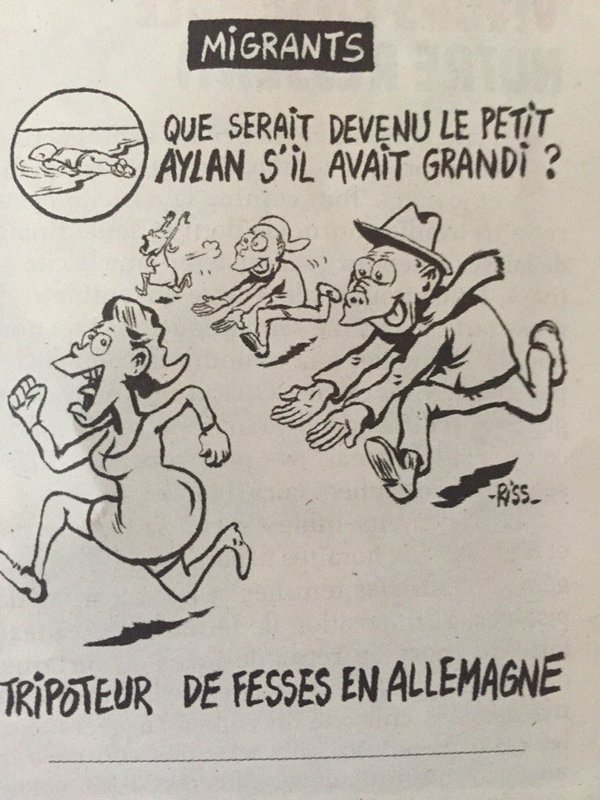
Pourquoi est-ce raciste ?
Un acte raciste, c’est attribuer un trait de caractère à une personne exclusivement à partir de son apparence (réelle ou imaginaire) à une communauté. Sur ce dessin, le lecteur doit comprendre qu’Aylan, qui est mort sur une plage de Turquie lorsque ses parents essayaient d’échapper à la guerre civile en Syrie, est un arabe[2]. Les violeurs et agresseurs de Cologne sont considérés comme étant des arabes. Aylan est un arabe, les violeurs sont des arabes, donc Aylan est un violeur. C’est un raisonnement typiquement raciste, un peu comme “il y a des noirs qui dansent bien, puisque tu es noir tu dois savoir bien danser.”
Racist cartoons
On 13 January 2016, I published a tweet denouncing the racist character of a drawing by a Charlie Hebdo staffer. It provoked outraged reactions from people defending the cartoon. It saddens me immensely that I have to explain them why the cartoon is, indeed, racist, and why it matters.
The drawing is reproduced below for the purpose of this analysis[1]. It says “What if Aylan had lived? He would have become an ass-groper in Germany.”
Don't ask too much from data literacy
This essay is written for a special issue of the Journal of Community Informatics on data literacy[1]. In the call for submissions, the journal points out that some argue that more data literacy will foster greater transparency, thanks to better use of open data, and let citizens better engage with science. With regards to journalism, I argue here that this view is mistaken.
“Datajournalism is social science on a deadline”, once said Steven Doig, a Pulitzer-prize winner[2]. Indeed, doing journalism with structured data requires that journalists use the social scientist’s toolbox, from data collection to data analysis. Data literacy is needed at every step of the process: To know what data to collect, understand biases in a data set, perform sensible analyses and visualize the results properly.