Speed and the slowdown of History
Technology increases the pace of change. This assertion is said so often that I have yet to find someone challenge it seriously. However, I argue that increases in speed, whether transport or communication, actually decreases the pace of political change. Take these three six-year sequences as examples.
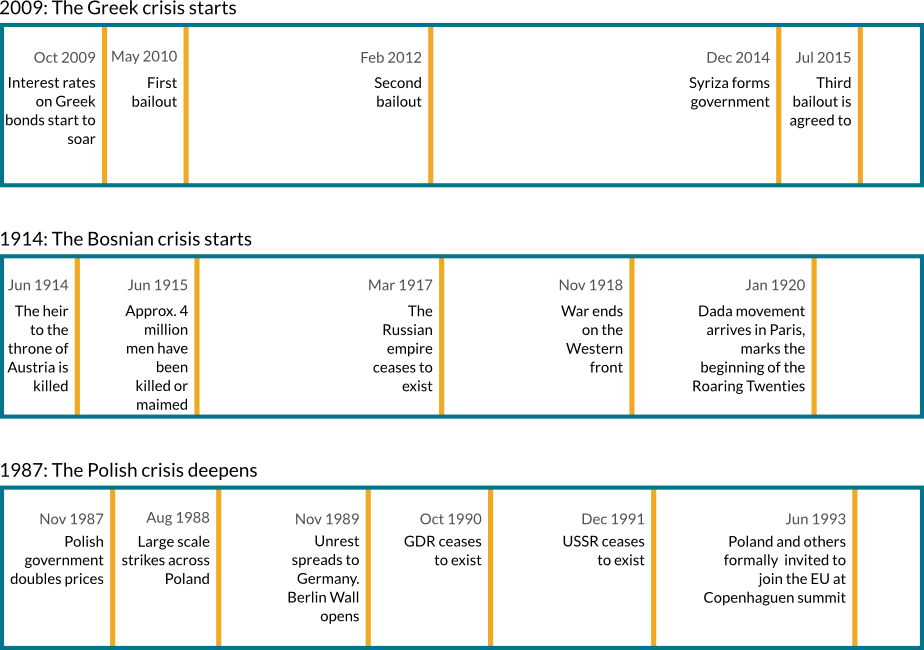
The three examples above, for all their flaws, show that the current European crisis unfolds at a dramatically slow pace. Despite the major changes (the banking union, the change in the ECB’s behavior in 2012 etc.), life for European citizens has not changed dramatically since 2009. Being unemployed is not the same as having a family member killed in the army or undergoing the change from communism to breakneck free-market economics.
Why start a blog in 2015
Starting a blog in 2004 was cool. Starting one in 2015 is anachronistic. But I found no other place to write more than 140 characters, use a versioning system and retain full ownership and control over form and content.
I intend to use this space to write down the contents of some of my talks, but mostly to expand on conversations I have with friends. In writing, one quickly finds the gaps in reasoning – and one must fill them or admit the weakness of an argument.
Singularity
One day, some say, computers will be able to build other computers without human intervention. They will build machines that are better than they are and, in a snowball effect, become more intelligent than humans. This day, to some, is known as Singularity. If you ever watched The Matrix, this should be familiar.
However, this vision of the future is wrong. Computers do not think. Computers are not capable of intelligence comparable to humans. Computers add numbers. They do it very, very fast. In this sense, computers have been more intelligent than humans ever since Alan Turing built his first machine in 1942.
Journalism schools must become information management schools
In the 20th century, journalists were people who worked in a newsroom, i.e who had access to the means of mass publishing or broadcasting. Now that everyone can publish to a potentially wide audience, the meaning of journalism has evolved. Journalism is now the act of adding value to an information in the public interest.
This change profoundly impacts journalism education. In all European countries, most journalists are trained in journalism schools, whether public or private. These institutions teach above all technical elements (writing a story, video and audio recording, online editing, fact-checking etc.) What distinguishes them from communication or multimedia schools is that they see themselves as the hatching nest for the representatives of the fourth estate. Even in Russia, a European country that has never had a full decade of free speech, journalism schools celebrate their exiled alumni who managed to become investigative journalists.