Meyer revisited
This is the write-up of a talk I gave at the SciCAR conference in Dortmund on September 7, 2017.
The organizers of the conference asked me to prepare a talk called “Meyer Revisited”. Philip Meyer is well-known in datajournalism circles. He was among the first ones to use the methods of social science for journalistic purposes - and it turned out to be a great idea. That was close to fifty years ago, so it might be time to take a modern look at the ground-breaking book Meyer wrote in the late 1960’s and revamped in a new edition in 1991, Precision Journalism.
What could Google do? (If it cared about journalism)
I wrote this post on June 4th, 2016. I did not publish it at the time, due to conflicting interests. Now that they are gone, the piece is yours to read, in its original version.
In April 2015, Google said it wanted to be a “friend and a partner to the news industry”.1 On that occasion, Google created a money pot worth €150m for European publishers, the Digital News Initiative (DNI), to be spent over a few years.2 The amount represents about 30 hours’ worth of Google’s global revenues.3
Airport controls
Airports are fascinating places. There, otherwise reasonable people accept to pose for nude photographs in front of total strangers (in the so-called full-body scanners). Of course, they are told that the pictures are destroyed on the spot, but numerous leaks of nudes have surfaced over the years.1 A film star even claimed he was asked to autograph a nude portrait of himself at Heathrow,2 although the airport denied this.3
Besides nude portraits, otherwise reasonable people accept to have their luggage searched - and commented - by “wholly untrained agents”, as a friend who’s a former security entrepreneur put it.4 It might not be much of a hassle if you conform to the idea of normality, but agents do not hesitate to humiliate and mock people who carry items they deem laughable.5 The list of behaviors otherwise reasonable people submit to when they are in an airport could go on (enhanced pat-down, anyone?) but we accept them in the name of “security”.
Ich bin jetzt Deutscher
Am 13.7.2017 bin ich Deutscher geworden. Ich erwartete etwas Symbolisches, aber ich bekam nur eine Mappe aus günstigem Karton mit dem Berliner Wappen auf dem Cover. Neue amerikanische Bürger bekommen einen Brief vom US Präsident ; ich habe ein grünes Einbürgerungszertifikat und die Aufforderung, so schnell wie möglich einen Ausweis herstellen zu lassen, bekommen. Das Deutschtum kommt mit seinen Pflichten.
Das einzige Symbolische an meinem Deutschwerden war, dass ich laut deklamieren musste, dass ich das Grundgesetz respektieren würde (es wäre natürlich symbolischer geworden, hätte meine Betreuerin nicht gelacht, als ich es gelesen habe). Natürlich werde ich das Grundgesetz ehren! Sein erster Satz ist eigentlich der Grund, warum ich in Deutschland leben wollte. Das der nur eine leere Floskel war, habe ich inzwischen begriffen. Die Würde des Menschen wird auch in Deutschland angetastet, nicht zuletzt vom Staat. Aber immerhin, ich habe hier mein Geld und mein Herz angelegt, und es gibt nirgendwo auf dieser Erde, wo die Aussichten besser sind.
The Humanist Paradox
Ever since I started to study history, I’ve been obsessed with one question. Everywhere the humanist project traveled, it brought with it racism and massacres, from Congo to Wounded Knee to Tasmania. Sven Lindqvist, a Swedish author, puts it beautifully when he says that “the idea of extermination lies no further from the heart of humanism than Buchenwald lies from the Goethehaus in Weimar”.1 Is this a coincidence, or is racism a part of humanism? This is what I pompously called the Humanist Paradox.
Cinq nouvelles absurdes de Géorgie
J’ai été témoin de ces histoires en Géorgie, en juin 2017. Tout y est authentique et si certains évènements ne se sont pas passés exactement comme je le raconte, c’est uniquement parce que la réalité a décidé de s’éloigner de ma version.
Merci à J.Z.F., A.L.B. et B.B. pour leurs conseils et leur relecture.
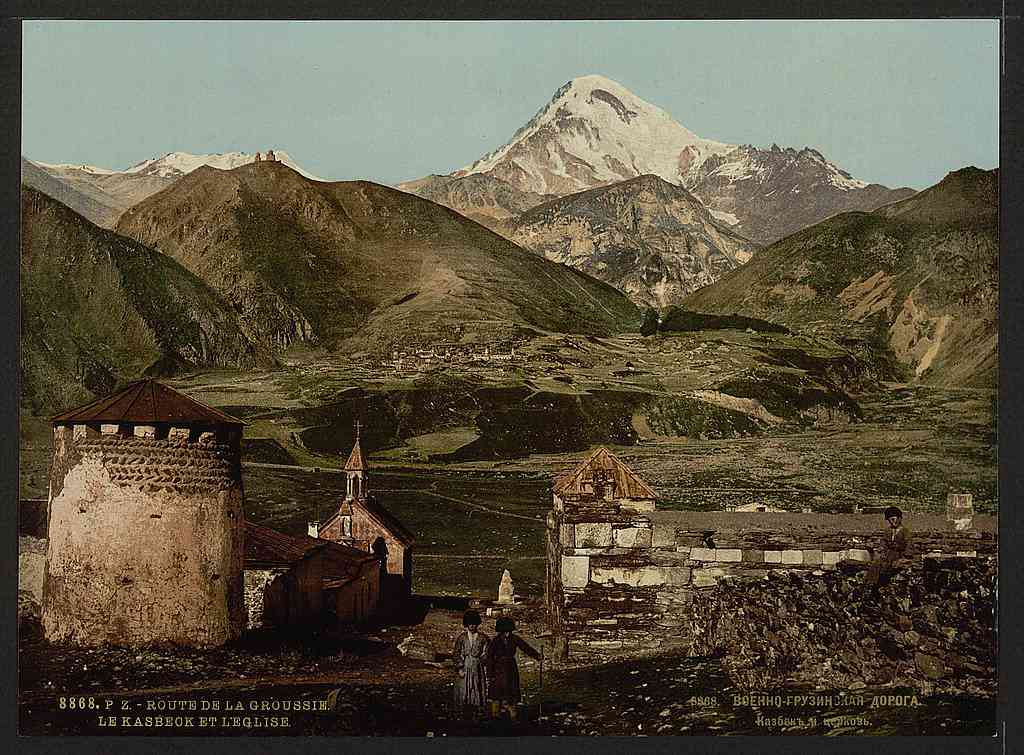
La sorcière de la maison bleue
Il y avait en Géorgie une vallée bordée d’immenses montagnes. Leurs sommets étaient tellement hauts que les nuages toujours les cachaient ; il était fort rare que les habitants de la vallée puisse les apercevoir. Enserré par ces montagnes se trouvait un village, où depuis des temps immémoriaux les bergers descendaient une fois l’an pour vendre quelques maigres bêtes et acheter qui du savon, qui un vêtement avec les quelques roubles qui leur restaient après leur visite à la taverne. Depuis quelques années, les roubles s’étaient transformés en dollars, les bergers en guides touristiques et leurs troupeaux, grâce à la suppression des droits de douanes et au talent de quelque génie du commerce, en Mitsubishi Delica, des minibus tout-terrains d’occasion importés du Japon.
Les clés pour comprendre
Un soir de mai dernier, mon ami Gaylord Vermouth1 m’a reproché de dénoncer les travers du système politique sans donner « les clés pour comprendre ». Il faudrait, m’a-t-il répété, que j’explique ce qui était bien et moins bien dans les programmes des candidats. Je n’ai malheureusement ni le temps ni les compétences pour faire ce travail,2 mon cher Gaylord, mais je vais te donner trois clés avec lesquelles tu pourras juger tous les programmes de tous les candidats, pour les élections à venir et même pour les suivantes. C’est du lourd, c’est puissant, fais en bon usage.
Things learned in 5 years of Journalism++
In early April 2017, together with Pierre Romera and Anne-Lise Bouyer, we decided to shut down Journalism++ Paris/Berlin, the datajournalism agency we created over five years earlier (Journalism++ Porto and Stockholm, our sister companies, are not affected by this change).
We created the company in 2011. It feels like another era. Wikileaks had just shown how large data dumps could change the techniques and processes of investigative journalism. Open data was blossoming everywhere. In politics, Sarkozy and Barroso were on their way out, the Poles had just given a new majority to Civic Platform and the only pressing question was whether the Euro would survive the winter. Good old days, in retrospect. In this environment, we set out to do three things: Build a European company, improve journalism (“Journalism++” literally means “journalism = journalism + 1” in most programming languages) and create a sustainable business. It was crazy ambitious and, back then, I didn’t think we would survive more than three years.
La parole d'un arabe
J’ai assisté à une audience de correctionnelle (enfin, son équivalent allemand). Voici l’histoire, telle qu’elle s’est déroulée.
Il s’appelle Mohammed, mais il se fait appeler Johnny.1 Sur sa chaise, il écoute le procureur lire l’acte d’accusation. Coups et blessures, injures et tentative d’extorsion commises contre une femme, Sabine, dans un bar, une nuit de 2016.
Le juge lui demande ce qu’il s’est passé, cette nuit là.
‒ Rien du tout! Je n’ai rien fait! Elle a tout inventé!
The collapse of academia
One day of April 2014, I found myself in a conference room, on the top floor of a brand new building, in a top European university. I was speaking to a group of PhDs, doctors and professors from some of Europe’s most prestigious research institutions. I was part of this group because the company I worked at was a (very minor) partner in a research project with all these major scientists. I made my presentation. I explained the hypotheses we made and how we designed an experiment to test them. I explained how the results of the experiment, along with on-the-ground observation, showed that some of the assumptions of the project were probably wrong.